
On Android bet365 app download for Android 2. Generally, three paths emerge when searching: mobile site, app or APK, and login page. The problem is—without understanding which of these three is the actual usage path and which is a redirect, fake download page, or fake login form, one could risk data, passwords, or device access.
3. Therefore, the first decision should be very simple: do you really need to install something, or can it be done through the browser? And if any page wants to provide an APK or wants you to log in, then first check the domain, redirect behavior, permission request, and the normality of the form.
4. Mobile site, app, and APK: what is the difference on Android?
10. Even if it says so, the user's needs are generally one or more of the following types: 5. The term does not always mean the same thing. On Android, it can appear in several ways:
- Mobile site6. : opens in the browser, usually does not require a separate download
- 7. Web shortcut8. : an icon is added to the home screen like an app, but it is browser-dependent
- 9. Native app10. : installs separately
- APK file11. : a direct Android installation file, which can also come from outside the store
12. If this difference is not understood, users may end up on a page that looks like an app page but is actually created just for data collection, redirect, or fake login. So download 13. instead of heading straight to install, try to understand what you are actually 14. looking for, or 15. from search result to fake download page: what could the risky path look like APK file।

16. A typical mobile journey might be: you searched, entered the first result, then a page said “latest APK.” After clicking there, it redirected to another domain, then a download prompt appeared, asking to enable unknown sources before installation, and upon opening the app, it showed a login screen. This entire flow could be suspicious, even though there is a brand logo, update message, or polished design above.
17. In another scenario, the user searching for the app actually ends up on a login page. After entering the username-password, it may show a blank page, an error, or ask for login again. This behavior is often a sign of a fake form or credential harvesting.
18. In such searches, particularly those that are observed:
19. looks like an app page, but the domain changes repeatedly.
- It looks like an app page, but the domain keeps changing.
- “It says ”official“, ”safe“, ”latest APK", but there is no clear basis for verification.
- It creates pressure that you cannot proceed without installing.
- “It rushes by saying ”region version“ or ”special Android build".
- It starts asking for additional information or permissions before logging in.
What to verify first when you see an APK download.
APK is the Android installation file. It is not inherently bad—it's not right to assume that, but Unverified APK. It can be risky. Because it is possible to alter the file, add extra components, or insert malware.
This checklist is useful when you see an APK prompt:
| What to look for | Why it is important | Red flags |
|---|---|---|
| Domain/URL. | To understand whether the page is genuine or not. | The spelling is close but not exactly the same. |
| Redirect behavior | Is the page changing midway? | Passing through 2-3 domains in one click. |
| File naming. | Is the file unusual? | Very long, random, or version-heavy names. |
| Install pressure. | Is there a rush being created? | Countdown, warning, forced prompt. |
| Extra bundle | Is it adding something else with the APK? | VPN, cleaner, plugin, booster |
| Login timing | Does it show the form right after opening the app? | Asking for credentials immediately after installation |
If the page repeatedly says to enable unknown sources and then asks to download another installer, plugin, or helper app, that is a major warning sign. Similarly, if it asks for card, OTP, or account details before installation, you should stop.
Android permissions: Which requests may seem normal, which are suspicious
The permission request after APK installation is one of the most important steps. Because this is where many apps or fake apps try to gain more access than necessary on your device.
Not all permissions are bad. But some permissions are particularly concerning:
- SMS access: may create a risk of reading verification codes or messages
- Contacts access: may pull your address book
- Files/Storage access: if it asks for more file access than necessary, it may be suspicious
- Accessibility permission: increases the risk of screen control or observing user actions
- Overlay permission: may overlay the screen of another app to show fake prompts
- Notification access: may gain access to view codes, alerts, or private notifications
- Device admin type control: may make uninstallation difficult or create system-level pressure
The question should be: Is this permission reasonable in relation to the app's stated functions? If a typical login-centric or browsing-centric app suddenly starts asking for SMS, contacts, overlay, accessibility—all at once, that is very unusual behavior.
Also note:
- Does denying permission make the app completely unusable?
- Does the permission screen keep coming back?
- Is it asking for sensitive access before showing general information?
- Is it asking for deep device access for tasks that could be done in a browser?
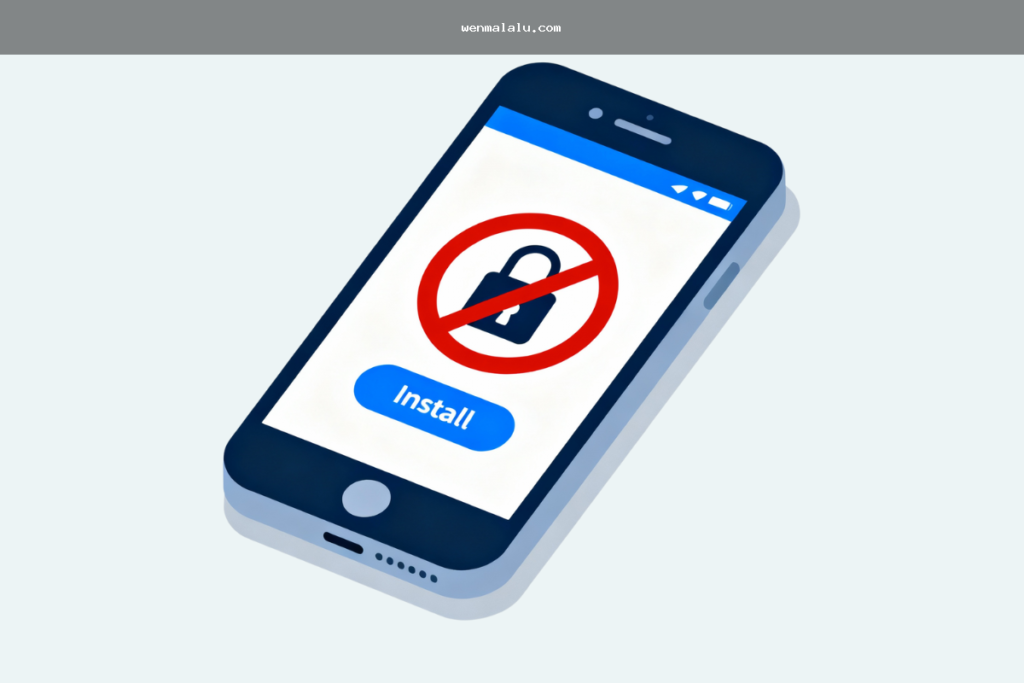
How to identify phishing and fake pages in mobile login?
Many users are actually looking for mobile login, not downloads. This is where the phishing risk is highest. Because fake pages usually copy the design, then try to collect username, password, OTP, or other sensitive information.
Pay attention to the following signs:
| login sign | Why suspicious | What to do. |
|---|---|---|
| domain suddenly different | could be a copied page | check the address bar |
| blank page after login | could indicate form data capture | exit immediately |
| asking for the password repeatedly | could be a credential retry trap | And do not provide information |
| OTP or code is being requested unusually | Phishing can occur in the name of extra verification | Do not provide without understanding the source |
| Password manager is not autofilling | There may be a domain mismatch | Disable manual login |
Some real habits help reduce risks:
- Not logging in repeatedly from new search results
- Not filling out forms without checking the browser address bar
- Taking a password manager mismatch as a warning
- Stopping if the language, layout, spacing, or error behavior on the login page seems unusual
- Not using the same password on another account
If you suspect you have provided information on a fake page, then quickly:
- Change your password
- Change those that have the same password elsewhere
- Enable 2FA if available
- Run a malware scan on the device
Can the work be done through the browser, or is installation needed?
Often, the user's real need is not the app, just mobile access. In that case, browser-based use may be less risky than installation, as it avoids unknown APKs, extra installers, or deep permission requests.
So ask yourself three questions:
- Do I just want to access the page on mobile?
- Is it possible to do necessary tasks without installation?
- Is the page unnecessarily pushing me towards the APK?
If necessary access is possible in the browser, then there may not be a need to pressure for APK installation. And if it seems necessary to install, do not download any file without completing the verification step first.
What decision will you make now?
Bet365 app download for Android After searching, the safest decision is usually not to rush. If you encounter these three things together: mobile site, APK prompt, and login page, then follow this decision path:
- If only access is needed: First check if the mobile site can be used in the browser
- When the APK appears: Do not install without verifying the domain, redirect, file name, and permission request
- When the login page appears: If the domain does not match, if the password manager does not autofill, or if OTP is requested unusually, do not log in
- If in doubt: Do not install, do not log in, do not share personal information
The most important thing is that you cannot trust just because of a polished page or app-like design. It is very easy to end up on the wrong page in such searches on Android. So verify first, then proceed with any download, login, or data entry.